Thursday, 23 May 2013

Juno ropes aren't actually snakes.....

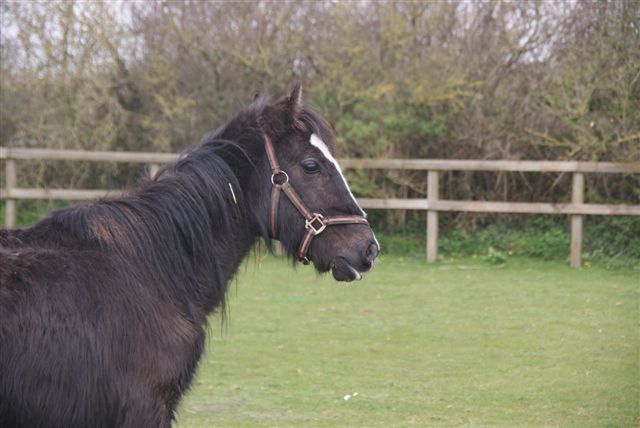
Juno is an 11 month old filly who has just begun to realise that (most) humans are not going to eat her, and that actually, we can give pretty good scratches. Having spent most of her short life actively avoiding all human contact, she is very adept at evasion. Breaking free and running away, jumping field boundaries, trying to leap out of stables, turning her bottom and threatening to kick are a few examples from her repertoire, all of which have been effectively used to avoid entrapment by a human. In her mind, each time she uses one of these tactics it becomes a successful method of avoiding perceived trouble, and therefore becomes a learnt behaviour and is more likely to be repeated. 

We have to remember here, that she is not 'naughty', 'cunning' or 'devious'. She is just a horse with instincts that tell her not to interact with a predator. Whether we like it our not, us humans are naturally predators. We have eyes on the front of our head, walk in straight lines, are very task focused, our hands look like claws and we move with intent. Compare this with the horse, a prey animal. They have eyes on the sides of their heads to allow almost all round vision. They move in a series of meandering arcs, combining grazing with keeping a watchful eye for predators. They do not have hidden agendas, creep up or jump out and their sole aims are to eat, sleep, stay alive and breed. They do not have ambitions, desires or wants outside of this. They do not wake up in the morning and plan out their day or wonder what tomorrow will bring. They live in the moment, doing what they believe necessary to stay alive here and now.

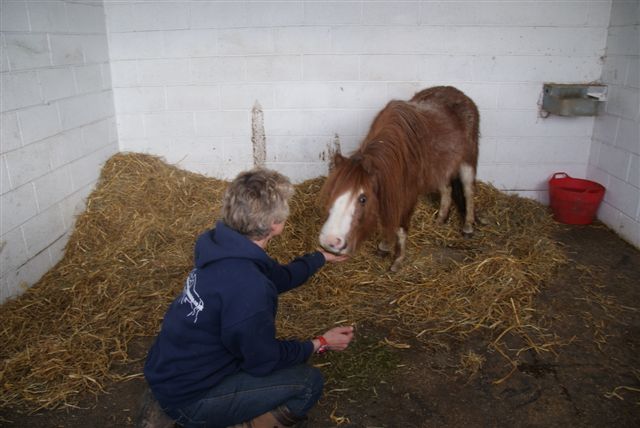
I have worked with Juno over a series of six sessions now, using advance and retreat and body language. I began with the feather duster, and then moved onto my hands. I then realised she was pretty fearful of the rope, possibly as she has run with it a few times, and now believes it can chase her. So, I did a significant amount of work using advance and retreat with the rope, so she can tolerate being stroked with it.

I have worked very incrementally to build Juno's confidence and trust, always aiming to consolidate each stage of learning before moving onto the next. Today's session was extremely rewarding. We saw an incredible amount of licking, chewing and sighing, and Juno really softened and relaxed into my touch. There is still a long way to go, but this little filly's world must already be a lot less stressful now she realises that she is not on our menu.


Thursday, 16 May 2013

What's the story, Jackanory?

Jack was born on the Quantock Hills and sold for very little money to a lady in Somerset, who wanted him as a companion for her older horse. This owner realised that he needed some specialist training and so contacted Sarah Weston, who went to do some handling with him back in 2011. Sarah made fantastic progress with him, but his owner still found she was struggling to put the concepts into practise. I lived only a few miles from Jack and knowing I needed case studies, Sarah kindly put me in touch with Jack's owners, and I went along to help. I did several sessions over about a month, during which time we made significant progress. I was able to put Jack's head collar on, touch all over his body and did a small amount of leading around the barn he was in. He wasn't easy- he had learnt that if he turned his bottom and threatened to kick, then his handler would move out of the way, and he would also try biting and barging. I really felt he would benefit from being able to go out in the field, and let off some of the pent up energy and frustration he so clearly felt. However, his owner was worried that she wouldn't be able to catch him again.

Using advance and retreat with the feather duster to encourage Jack to accept touch.


Jack's owner decided it was unfair to keep Jack in the barn, and didn't feel she was able to continue handling him on her own.  Having made such progress with this bold little guy I was extremely determined to find him a home. I contacted everyone I could think of, but no-one could take him. I then suggested that if his owner would have him gelded, I would take him. Thankfully, the work I had done with him was ideal preparation for the vet's visit, and Jack accepted the sedative easily from the vet. A couple of weeks later he arrived at his new home, and was put straight out in the field with some new friends....

Jack catching up on 'being a horse'


Jack spent the next couple of weeks in the field socialising, playing and eating grass. Having being kept in isolation in a barn for half of his short life, I felt it was so important for him to be allowed time just to be a horse and catch up on his social skills. I did very little with him for a couple of weeks. When I did start working with him again, the change was remarkable. He allowed me to approach using advance and retreat and give him a lovely deep rub with my hands. I began bringing him onto the concrete yard during the day with my big Irish Draught horse, who comes in on a daily basis to keep his feet in good condition. Whereas it had previously taken as long as half an hour to get the head collar on I was now able to achieve this in just a few minutes. So much of the pent up frustration had disappeared.


Jack enjoying a cool shower on a warm day, spring 2012

Jack is now 3 years old, and through gentle work, on a 'little and often' basis it would be difficult to know he was once a semi- feral pony. I rasp his feet which are in great condition. He now long lines confidently through the lanes and bridleways, and I have started gently bellying over him. He enjoys a shower and is the first one to investigate anything new- you can't leave anything within nibbling distance! I try and designate at least one day a week as 'Jack day'- and aim to continue to incrementally build his confidence and trust to nurture his naturally bold and inquisitive nature.

Jack relaxing with friends


Long lining calmly past the cows


Long lining on the lanes


Long lining through fields


Friday, 10 May 2013

Roly, George, Ripple and Louie

I have now visited Simon and Emma three times. It is a real pleasure to see the progress they have made with their lovely herd of four. Each of the ponies has a different story to tell, and they are all very individual characters. Simon and Emma are having to adjust their energy levels and body language according to who they are working with and what level they are working at. All four ponies live out together, in large paddocks with a field shelter and supplementary feed when necessary throughout the winter months.

Roly is a pure-bred 3 year old Fell pony. He has been with Emma and Simon since early December 2012, prior to which he lived in a herd environment at a stud farm in Cornwall where he received minimal handling. He came to them as an entire colt, and since I first met him we have made a great deal of progress (listed below), including that he is now gelded.

* Acceptance of headcollar through a combination of advance and retreat work and clicker training. Roly can now easily be caught in the field with minimal fuss.
* Desensitisation to touch over body and legs, through advance and retreat work with a feather duster leading onto acceptance of touch with hands. Roly is very wary of his back legs being handled and the next stage is to thoroughly desensitise them using the feather duster and the hand on the stick, before we move onto using our hands. We want to ensure this is completely consolidated before we begin to ask him to lift his feet up.
* Improved understanding of pressure and release, and leading off the headcollar.
* Work over unfamiliar surfaces including a blanket, tarpaulin and poles.
* Greater awareness and understanding of personal space, using bodylanguage. Roly is very typical of a young colt, in that he continually explores the boundaries of acceptable/unacceptable behaviour. Simon is naturally very laid back, and has had to really raise his energy levels and use big body language, making his requests as black and white as possible, to ensure Roly understands personal space and respects humans as leaders. We have had some wonderful moments where Roly has completely relaxed, with lots of evidence of licking and chewing and perfect stillness as he learns to accept touch.


Accepting the headcollar


A lovely rub between the eyes


Walking around the tarpaulin before approaching


Walking over the blanket/tarpaulin


Advance and retreat with the feather duster


Accepting touch with the feather duster


Leg handling


George is a 14yr old gelding, and has been owned by Simon and Emma for 2 years. George has previously been in an equine college and it is suspected that he may have been ridden pretty hard and may have sore hocks. On my first visit Simon and Emma described George as 'leader' of the herd, and felt he may suffer separation anxiety when asked to leave his companions. They also told me he can be fidgety, anxious and rears on occasions. Many people have suggested it may be sensible to consider selling George, as he can be a real handful....


George running across the field having broken free whilst leading

George rearing

The first time I met George he was extremely distracted. He was reluctant to stand still, and demonstrated huge surges in his adrenaline levels. We introduced a feather duster to him at the beginning of the first session and his reaction was pretty explosive! He was very fidgety and had a poor understanding of personal space, quite happily standing on top of his handler and ignoring requests on the leadline. He was far more concerned about what the rest of the herd was doing and was clearly quite anxious to be separated from them.

Simon has done a great deal of work with George, including;
* Lots of leading work, including changes of direction, backing up, walk trot and halt transitions. This has greatly improved George's understanding of personal space.
* Practising the 'L' for leather groundwork. This has been great for improving concentration, manoeuvrability, suppleness, responsiveness, body language and timing.
* Desensitisation work with unfamiliar objects such as feather duster, plastic bags, tarpaulin etc.
* Walking over and through various obstacles including blankets, tarpaulin, tyres, poles.
* Long lining in the field and on the road.
* Lots of work of a long line, increasing the time that George will stand still for and encouraging him to respond to body language.
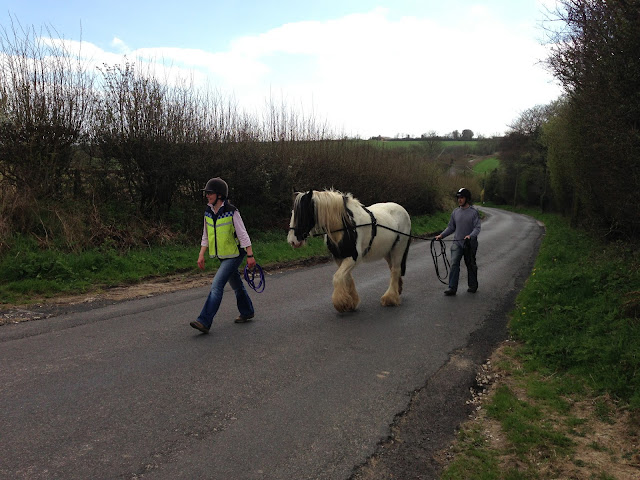
A happy and relaxed George, longlining down the lane.

The difference in George is wonderful to see. It is clear that he now views Simon as a leader and is happy to trust the responsibility of the herd's safety to him. He is no longer anxious to be separated from the herd, and comes in happily from the field. His head carriage is lower and his eye and jaw are soft and relaxed. He stands still and concentrates on the task in hand rather than the other horses in the field. He will stand calmly and accept touch all over his body from the plastic bag, and confidently long lines out on the road without so much as a backwards glance to his friends in the field. Simon is happily looking forward to further building on the trust and confidence that he has already made huge progress with, and hopes to one day consider horseback archery!

Ripple is a 10yr old Fell pony mare. She came from the same place as Roly, but lived in a different herd. She has also been with Emma and Simon since December, and is due to foal in around a month. She has probably had a foal almost every year of her life, so knows what she's doing, but it's all very exciting for Emma and Simon, who want to ensure the best start for their new arrival.

I have never met such a gentle and good natured, unhandled pony. Ripple is incredibly naive and has no idea at all about personal space, leading or pressure. However, she accepts people very willingly and seems desperate to please. Simon and Emma are going to be doing little and often with her, as she has never had any training at all, and is very heavily pregnant.

Louie is a 15year old Fell pony gelding. He has been owned by Emma for 3 years. There is some unknown background history, and we know that Louie has been roughly treated in the past. The yard that he came from labelled him 'dangerous', although Emma witnessed him being booted in the belly to get him to 'walk on' whilst he was there. Whilst on this yard, his management routine involved him being stabled for most of the time, with little social contact or natural light. Emma says he is a completely different character since they brought their fields and moved him to live with their other horses, living out 24 hours a day.

Emma and Louie have a good relationship, so the work we do is all about finishing touches and subtle improvements. Slight changes to body language and energy levels, and greater self discipline with regards to personal space and standing still will further instill Louie's regard for Emma as a worthy leader. We use exercises such as 'L' for leather, leading transitions and long lining.


Thursday, 25 April 2013

Cuthbert the luscious and other friends...

I enjoyed a day-trip to Horseworld at the weekend, during which time Sarah Weston and I did a bit of work with a few of the residents there. The highlight for me had to be watching Sarah doing a demo at the visitor centre with beautiful coloured horse called Cuthbert. He had arrived at Horseworld as a stallion and had to be kept entire whilst they waited for the prosecution against his former owners to go through. He was gelded earlier this year and has just begun his education under saddle. He really is a beautiful horse, and I was sorely tempted by him as my next 'classical' project.  One young visitor summed it up when she remarked that 'Cuthbert is lush' after he was longreined and ridden for only the second time during the demo at the visitor centre. He has great potential and will make somebody a very good ridden horse.

I also worked with a very tiny filly called Patience who had been seized as a result of a neglect and cruelty case and taken to Horseworld on the brink of collapse. You can see her in the photos, looking very skinny, but much better than when she first arrived thanks to the care and expertise of the staff at the centre. We worked very quietly and informally with her in her paddock just getting her used to the presence of people.


 This little mare arrived as a result of a cuelty case and is due to have her foal at any time soon.


 One of the newest arrivals at Horseworld, whose Mum was thankfully rescued and arrived at the centre before she gave birth.
 Rusty is absolutely petrified of people, possibly the result of being roughly handled and pinned down. We work with her quietly using advance and retreat in a small space, but she finds it very difficult to deal with and spins, charges round and throws herself on the floor in sheer panic. She does however, have a good interest in food, so there is hope that clicker training might be effective with her.A huge amount of time and patience will be required to make progress with this little mare.


Hands On Horsemanship Courses at Horseworld, Bristol


Bronwen was teaching on The Hands on Horsemanship courses this weekend, with some really fab students, both equine and human. There are upto 140 horses at any one time, at this amazing venue- each of them with their own story to tell. With such fabulous facilites and a huge variety of horses and ponies to choose from, we can tailor make the course to suit the requirements of our students, thereby ensuring that everyone gets an educational, informative and practical 'hands on' day! We pride ourselves on being friendly, approachable and flexible, and treat every horse and human as an individual. We can't wait for the next dates in July! For more info see the 'Hands on Horsemanship' facebook page or conact me.

Thursday, 18 April 2013

Getting to the root cause of a behavioural problem....

I have been out to two clients recently who have called me out for help improving their confidence. One of them has a beautiful Fell pony. She brought the pony and kept him at a yard in Dorset, where she quickly realised that the situation was far from ideal. The yard owner's answer to many of the problems she was having was violence- at one point the yard owner kicked the pony in the belly in answer to her request for help to get him going forwards from the leg. The pony was labelled as 'dangerous' and she was told he had a long list of behavioural problems. He became known as the 'psycho' pony.

Turns out he was rarely used in the riding school when they said he would be, and neither did he get turned out in the field. The owner realised a lot of his behaviour was related to the way he was managed, so decided to move him. He now lives out in a large field with three other ponies, and not surprisingly, is a completely different character.

The second lady has a gorgeous traditional cob type horse. She feels it is her confidence that is the 'problem'. However, once I begin chatting to her I realise he lives in a dark isolated stable block for 23 hours of the day. The walls are made of plywood, so there's no visual stimulation or natural light. The only time he feels grass under his feet or enjoys any kind of social contact is during a hack. When his owner asks for support with her riding she is stuck at the rear of a ride and ignored, whilst the other riders chat amongst themselves. This means she has to deal with her rising anxiety levels alone. On one occasion when her horse began getting slightly excited as they walked through a field she said she wanted to get off. The ride leader swapped horses with her and gave the cob a few hefty smacks with her whip and told him to 'Get On'.

These clients live pretty close to one another- in fact, when I delved a little deeper I realised it was exactly the same yard which they were having problems with!

I am so pleased that the cob's owner remained loyal to her instincts and recognised that the advice she was getting from those around her on the yard was not positive or helpful. It is so easy to follow suite. Thankfully, having been to a few 'Monty' demo's and read a few of Kelly's books she knew there was another way and I hope that through me she will be able to talk to a few like minded people in the local area and build up a support network.

Sadly, I see this time and time again. I have first hand experience of management affecting behaviour. One of my own horses is an ex 'dangerous' beast who was due to be shot because he was 'unhandlable'. Nothing, of course, to do with the fact he had lived on his own in a small space in a barn for 6 months between the ages of 6 months and a year, with testosterone coursing through his veins and all that baby playfulness pent up inside him!

I would like to ask all those people who keep their horses in a small box for 23 hours a day, devoid of social contact, to sit in a small room with nothing but an endless supply of ryvita and water. Do this for 23 hours a day for a week, only coming out to be grilled by a personal trainer and then perhaps you might empathise with your dangerously excited, wild beast of a horse.

Thursday, 21 March 2013

Yeeehhaaaa!!! Made it!

This is my first Blog as a Recommended Associate of Intelligent Horsemanship. I was aiming to become qualified by the time I hit the big 30, and I'm pleased to report that I offcially made it! It’s been a long old journey to get to this point (as my long-suffering husband will tell you). I always knew I wanted to work with horses, and at aged 17 began the first part of my formal equine education studying at Bicton College, in Devon.
I was there for three years, and as well as making some life-long friends, I developed a real passion for equine behaviour. I also realised my love for classical riding, having daily lessons from a very talented (if somewhat militant, and unsympathetic to incompetent young females) classical rider. At this point in time I knew nothing about correct riding, having spent my youth riding anything and everything that came my way, very much in an old traditional riding school style! Watching knowledgeable riders on well-schooled horses really opened a whole new world for me- and although I was quickly assigned to the bottom riding set, I was determined that one day I would be able to ‘ride like that’.
I will always remember a lesson with Clare Sansom towards the end of my time at Bicton, where I suddenly had that ‘light bulb’ moment. Clare exclaimed in her ‘jolly hockey sticks’ manner; ‘Jenny, I have never seen you ride like that!’ I was in total harmony with the horse. I realised what softness and lightness was, and how utterly different it felt when your horse was truly engaged and working ‘from behind’. To this day I find it difficult to find the words to describe that feeling. If only I could, perhaps my non-rider friends and family would understand the madness.
Bicton fuelled my thirst for knowledge, and from there I went onto Harper Adams University, Moreton Morrell Campus, Warwickshire to study a BSc (Hons) in Equine and Human Sports Science. My riding education continued, although the major learning there was theoretical. I was lucky enough to be involved in some science trials for Dobson and Horrell, where I looked at the time budgets of racehorses, recieving a varying forage to concentrate ratio. The results showed that high grain low forage rations caused stereotypical behaviour in all the horses, which ceased once the forage was increased. My lecturers used the study to look at the physiological results of such a regime and some very adverse physical effects were also evident.
After leaving university I worked for various sectors of the equine industry including a feed company, an international dressage rider, various riding schools and The Exmoor Pony Centre. Here I was lucky enough to meet Recommended Associate Sarah Weston, who was working with the Exmoor foals that had just come off the moor. Whilst watching Sarah work I breathed a sigh of relief – I had at last found a way of training horses that made complete sense to me; an ethos I could whole-heartedly believe in, an effective and logical method of working that was both practical and scientifically explainable.
Yet again, I was determined that 'One day I will be able to do that’. I decided then and there to start on the Intelligent Horsemanship courses, and never looked back. The tutors were friendly, experienced and knowledgable and the techniques and ethos just made perfect sense to me. After many courses, lots of homework, projects, revision, blood, sweat and tears, I undertook the MRPCH exam in summer 2011, and passed with distinction. From there I built up my case studies which were submitted in summer 2012, and am now a fully fledged IHRA looking forward to the next stage in my equine journey!